Honda Pilot Dead Battery Guide (Here’s Why & How To Fix)
There’s nothing more frustrating than finding that your car won’t start because the battery is dead. I understand your frustration.
Well, if you’ve just experienced something that ruined your day, I’m sorry to hear that.
But don’t worry—in this guide, I’ll walk you through exactly how to get it running again and what’s likely causing it to die in the first place.
How To Fix
If the reason your car won’t start is a low battery, you don’t need a mechanic to get it back on the road.
You just need to know where to connect the cables, but Honda doesn’t make this part very clear.
Step 1: Recharge the Battery or Jump Start the Vehicle
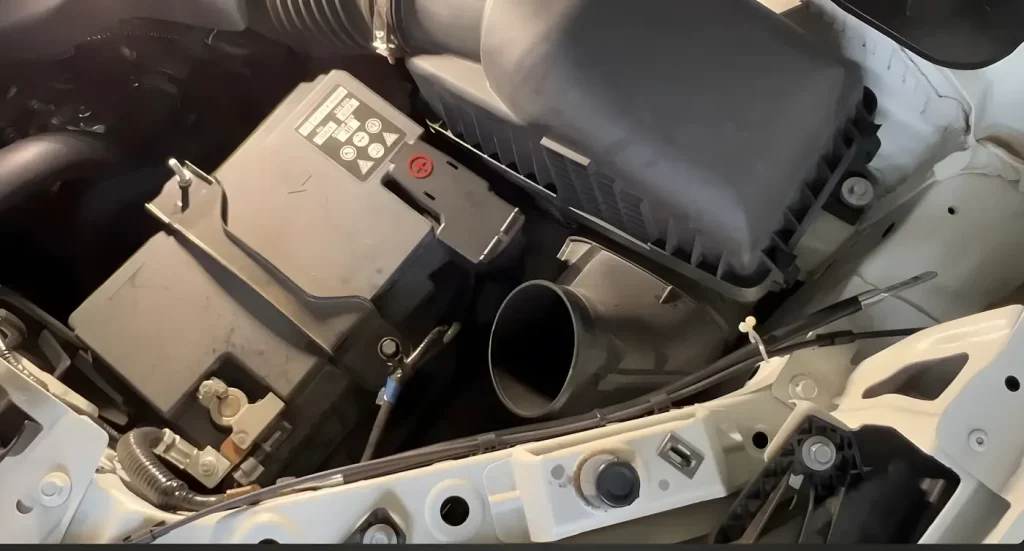
To charge the battery or jump-start it, you need access to the positive and negative terminals. Unfortunately, Honda doesn’t make that easy on the Pilot.
The battery sits in a somewhat hidden spot in the engine bay, and that makes reaching the terminals a bit of a pain.
The positive terminal isn’t too bad, you just remove a few plastic covers, and it’s right there.
The negative terminal is a different story. To get to it directly, you’d need to pull the air intake off, which is more hassle than most people want to deal with just to hook up a charger.
Here’s the workaround I use.
You don’t actually need the negative terminal itself. You can clamp the negative lead of your charger or jump starter onto any bare metal point on the car’s body instead.
That works because the battery’s negative terminal is connected to ground, meaning it’s electrically tied to the chassis anyway.
My go-to spot is the engine hanger. This engine hanger point is actually the recommended connection point for jumper cables listed in the Honda Pilot owner’s manual.
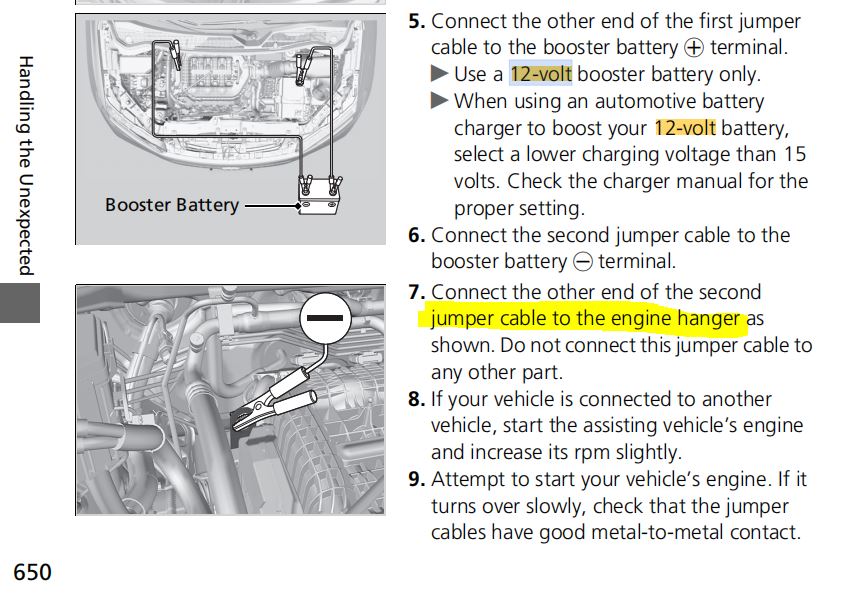
Unfortunately, the distance between the positive terminal on the battery and this engine hanger is quite far, so I’m worried the cables on my portable jump starter won’t reach.
An alternative is the bolt on the air filter housing; although it doesn’t always deliver power optimally, it works for me most of the time.
It’s connected directly to the body, which is indirectly connected to the battery’s negative terminal, and it’s much easier to reach than digging around near the intake.
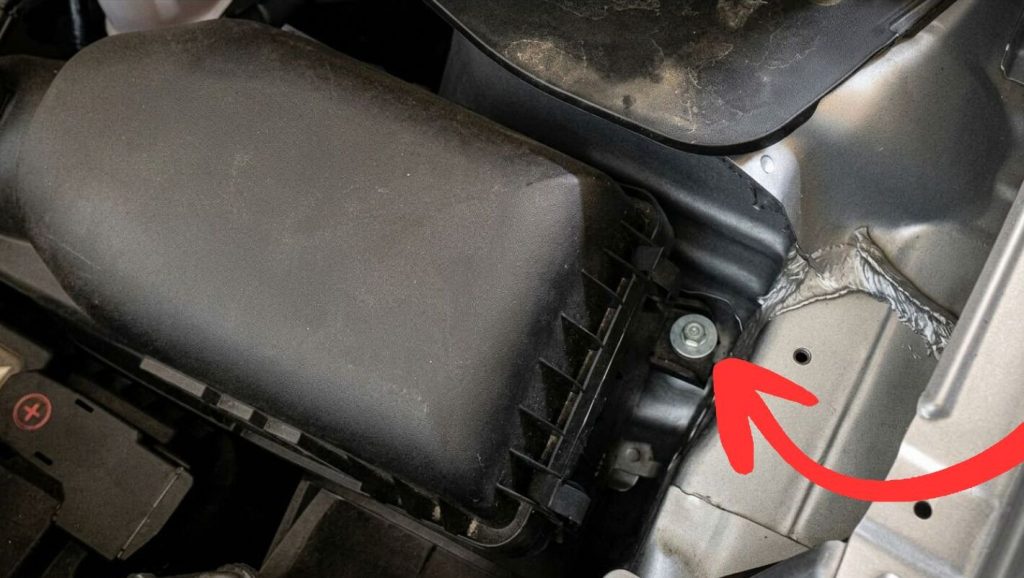
If you find yourself charging the battery often with a trickle charger, it’s worth running a short extension cable from that ground point so you’re not fumbling under the hood every time.
There’s a solid YouTube video showing this exact method, including the ground bolt trick, which you can see in action on this [Terminal Extension for Jump Starting Install Tutorial on YouTube]
Here’s how to jump-start the Pilot step by step:
- Position the vehicles. Park the running vehicle close to your Pilot, close enough that the jumper cables can reach both batteries comfortably.
- Access the terminals. Remove the plastic cover over the positive terminal. For the negative side, locate a clean, unpainted metal point, the air filter housing bolt works well.
- Connect the positive cable. Clamp one red clamp to the positive terminal of your Pilot’s battery, and the other red clamp to the positive terminal of the good battery.
- Connect the negative cable. Clamp one black clamp to the negative terminal of the good battery. Clamp the other black clamp to the ground point on your Pilot, not the battery’s negative post.
- Double-check the connections. Make sure every clamp has a solid, tight grip before you try to start anything.
- Start the working vehicle. Let it run for 1 to 3 minutes to feed some charge into the dead battery.
- Try starting the Pilot. If it cranks but doesn’t catch, give it another 10 minutes before trying again.
- Disconnect in reverse order. Remove the black clamp from your Pilot first, then the black clamp from the good battery, then both red clamps.
- Drive it for a while. Give it at least 20 to 30 minutes on the road so the alternator can top the battery back up.
No other car around? Well, maybe you should call the nearest repair shop. Several services provide emergency assistance for cars that won’t start due to a dead battery.
If you’re at home when this happens, it’s not a huge problem. It’s a different story if you’re out and about—for example, in a shopping mall parking lot or at the office. That’s when you might need to make a phone call.
To prevent this from happening again—or to avoid it altogether if you’ve never experienced it before—it’s a good idea to always keep a portable car jumper in your car.
Honestly, I’d strongly recommend just getting one and keeping it in the trunk. It saves you from ever having to wait around for another car or flag someone down.
My pick is the NOCO GB40. It’s known for being reliable, and it doesn’t cost a fortune. To be clear, this isn’t an affiliate recommendation; I just think it’s a solid unit worth having on hand.
If you’d rather just charge it slowly, a wall charger connected the same way (positive terminal, negative to the ground bolt) left overnight will usually bring a battery back if it’s still in decent shape.
Step 2: Check the Battery and Alternator
Once your Pilot is running again, don’t just move on with your day. Get the battery and charging system checked, especially if this isn’t the first time it’s happened.
If you’ve got a multimeter, you can test it yourself. A healthy battery should read around 12.6 volts with the engine off.
Start the engine and check again, you want to see somewhere around 13.5 to 14.5 volts.
If it’s not climbing into that range, the alternator likely isn’t charging the battery properly.
No multimeter? Most auto parts stores, like O’Reilly or AutoZone, will test both the battery and the alternator for free. It only takes a few minutes.
Step 3: Address the Underlying Problem
If you left the headlights on overnight, that’s an easy fix, it won’t happen again once you’re more careful.
But if the battery died for no obvious reason, or it keeps happening, there’s something else going on. Keep reading, because the next section covers the usual suspects.
Why Does the Car Battery Keep Draining?
A battery that dies once is normal. A battery that keeps dying is a symptom of something bigger. Here’s what’s usually behind it.
Electrical Components Left Running
This is the most common and the easiest to rule out.
Interior lights, headlights, or something plugged into the accessory outlet left running overnight can drain a battery by morning.
I’ve done this myself more than once, rushing out of the car and forgetting the dome light was still on.
Old Battery
Batteries wear out. A Honda Pilot’s battery typically lasts around 3 to 5 years, and once it starts to age, it loses its ability to hold a charge, even if nothing else is wrong.
If your battery is past that age range, testing it is a good first move before chasing anything more complicated.
Bad Alternator
The alternator’s job is to recharge the battery while the engine runs and to power your electronics so the battery isn’t doing all the work.
When it starts failing, the battery ends up covering the load with nothing coming back in return, and it drains fast.
Watch for these warning signs of a failing alternator:
- Dimming headlights or interior lights, especially at idle
- A battery warning light on the dash
- Accessories losing power while driving
Most alternators last somewhere between 80,000 and 150,000 miles, though that varies by driving conditions and build quality.
Parasitic Battery Issue
This one’s trickier. A parasitic draw happens when something keeps pulling power from the battery even after the car is off and locked.
On the Pilot, a few culprits show up again and again in owner forums and shop reports.
The A/C compressor clutch relay is a frequent offender. It can stick closed even with the engine off, quietly draining the battery without any other symptoms, the AC still works fine, so you’d never suspect it. It’s a cheap part to swap and worth ruling out early.
A door lock actuator or lock cylinder stuck partially engaged can also keep drawing current.
Some owners have traced drains to the Bluetooth or HandsFreeLink module not fully powering down, or to a dome light that doesn’t shut off properly when the doors close.
I’ve experienced this myself, but not with a Honda Pilot—rather, with a Ranger Truck.
I didn’t realize that some of the LEDs on the steering wheel and the instrument cluster weren’t turning off even when the car was turned off and locked.
As a result, the battery would die once a month; eventually, I had to replace it—which, let’s face it, wasn’t cheap.
If your battery keeps dying with no clear cause, a shop with a multimeter can measure the draw and pull fuses one at a time to isolate the circuit responsible. It takes patience, but it’s the most reliable way to track it down.
Battery Replacement Cost
If the battery itself is the problem, replacing it is usually the simplest fix. The right battery for your Pilot depends on the generation and trim, so it’s worth checking before you buy.
To check the battery size in your Pilot, look for the information on the battery cover. It’s located near the positive terminal.
3rd-generation Pilot (2016–2022): LX, EX, EX-L, and Sport trims without idle stop typically run a Group 24F flooded battery, usually around $150 to $220 installed. Touring, Elite, and Black Edition trims with the idle stop feature step up to a Group 48 (H6) AGM battery, which lands closer to $250 to $350 installed.
4th-generation Pilot (2023 and newer): Group 48/H6 AGM comes as standard equipment across most trims, so plan for the higher end of that range, $250 to $350 installed.
One thing worth clearing up: Group 48 and H6 are just two names for the same battery, not two different sizes.
The one you don’t want to mix up is Group 47 (H5), which sometimes gets listed for idle-stop Hondas too. It’s a similar AGM battery, but physically shorter and lower capacity than the Group 48/H6.
The two aren’t interchangeable, installing the wrong physical size can cause problems with the hold-down bracket.
FAQs
Make your Pilot battery last Longer
I have three cars in my garage. Like most people who own more than one car, there’s one that’s my favorite and that I use every day.
If you’re like me, that means you have the extra task of making sure the batteries in your other, rarely used cars don’t run low.
It’s simple: if you have enough time, drive each car for 20 or 30 minutes every week—that’s enough to make sure the batteries stay charged.
But if you don’t have time to drive them, get a trickle charger. It’s a device that charges the battery using a low-current method.
Unlike traditional fast chargers with 10 amps or even 50 amps, it works slowly with an output of 1 A—which is safer. Besides, the goal is to keep the battery fresh, not to recharge it from 0 to 100.
I have a few trickle chargers for recharging car and motorcycle batteries, as well as some devices at home. They’re small, inexpensive, but very useful.
But basically, I’d still recommend that you drive your car for 20 or 30 minutes—not only is it good for the battery’s health, but it’s also good for the engine, the cooling system, the suspension, and all the other parts of the car.
Do you have any further questions? Be sure to drop a comment below!

a cat lover, Honda driver, automotive enthusiast, and occasional photographer.
Nurjati is a proud Honda SUV owner and passionate content creator dedicated to sharing expert insights about full-size family SUVs.
His first car in school was a Honda, and she’s been in love with the brand ever since. With over 10 years of experience as a journalist and automotive blogger, Nurjati is committed to keeping enthusiasts and buyers informed and inspired.