Pilot Towing Capacity by Year & Real-World Use (2003-2026)
Honda’s three-row family SUV has quietly become one of the most popular tow vehicles on the used and new market — but the number printed on a brochure rarely tells the whole story.
A Honda Pilot rated at 5,000 lbs isn’t automatically capable of hitching up a 5,000-lb trailer straight off the lot, and a Pilot rated at 3,500 lbs might have room to spare depending on drivetrain, options, and how the vehicle is loaded.
This guide breaks down exactly what every Honda Pilot generation can tow, why the FWD and AWD numbers differ so much, and what equipment actually determines whether you’ll hit the vehicle’s maximum rating.
What You Must Know Before Towing with a Pilot
Before jumping into year-by-year numbers, it helps to understand three things that decide whether a Pilot tows 3,500 lbs or 5,000 lbs — because the difference rarely comes down to the engine.
1. FWD vs. AWD Changes Everything
Across nearly every Pilot generation, front-wheel-drive models are capped at 3,500 lbs while all-wheel-drive models can be rated as high as 5,000 lbs.
This isn’t a marketing decision — AWD Pilots put power down through all four wheels, which matters when a loaded trailer is pushing back on the drivetrain during acceleration, hill starts, or a slippery boat ramp. FWD models simply don’t have the traction margin to safely control that extra mass.
2. Tongue Weight and GVWR Matter as Much as the Towing Number
Tongue weight — the downward force the trailer’s hitch places on the vehicle — is typically limited to around 10% of the total trailer weight.
A Pilot rated to tow 5,000 lbs generally has a maximum tongue weight in the 500-lb range. Load the tongue weight past that limit and handling suffers regardless of what the tow rating says.
It’s also easy to overlook that towing capacity isn’t independent of passenger and cargo weight. GVWR (Gross Vehicle Weight Rating) accounts for everyone and everything already in the vehicle.
A full third row and a loaded cargo area reduce how much effective trailer weight is left before you exceed the vehicle’s total rated limit.
3. Transmission and Auxiliary Coolers Are Not Optional
Sustained towing generates far more heat in the transmission fluid than everyday driving.
On earlier Pilots especially, an auxiliary ATF (automatic transmission fluid) cooler — and on some model years, a supplemental power steering cooler — is what allows the vehicle to reach its maximum tow rating without risking transmission wear or overheating.
Skipping this hardware is one of the most common reasons owners run into problems well before the rated weight limit.
Quick Reference: Towing Capacity by Model Year
| Model Years | Generation | FWD Capacity | AWD Capacity | Required Equipment for Max Rating |
|---|---|---|---|---|
| 2003–2008 | Gen 1 | 3,500 lbs | Up to 4,500 lbs (VTM-4) | ATF cooler + power steering cooler |
| 2009–2014 | Gen 2 | 3,500 lbs | 4,500 lbs | Class III hitch + wiring harness |
| 2015 | Gen 2 | 3,500 lbs | 5,000 lbs | Factory tow package |
| 2016–2022 | Gen 3 | 3,500 lbs | 5,000 lbs | ATF cooler (AWD trims) |
| 2023–Present | Gen 4 | 3,500 lbs | 5,000 lbs | Class III hitch + wiring harness |
Honda Pilot Towing Capacity by Generation
Generation 1 (2003–2008)
The first-generation Pilot introduced Honda’s VTM-4 (Variable Torque Management-4WD) system and set the template that later generations would follow: a modest FWD ceiling and a meaningfully higher number for the all-wheel-drive version.
- Towing capacity: 3,500 lbs (FWD) / up to 4,500 lbs (VTM-4 AWD)
- Engine & Transmission: 3.5L SOHC V6 (J35), paired with a 5-speed automatic
- Drivetrain distinction: VTM-4 models generally carry a higher rating than FWD models, particularly for boat trailers versus enclosed box trailers, which create far more aerodynamic drag at highway speed
- Critical equipment: Honda’s official towing documentation for this generation calls for a factory or dealer-installed auxiliary transmission cooler (and power steering cooler on some configurations) to protect the 5-speed automatic under sustained load — this is not a “nice to have” for Gen 1 Pilots doing regular towing
Generation 2 (2009–2015)
The redesigned, more truck-like second generation carried over the V6/5-speed combination for most of its run but picked up meaningful structural reinforcement, which is part of why the AWD rating eventually climbed to 5,000 lbs by the final model year.
- Towing capacity: 3,500 lbs (FWD) / 4,500 lbs (AWD, 2009–2014), rising to 5,000 lbs (AWD, 2015)
- Engine & Transmission: 3.5L V6 with Variable Cylinder Management (VCM), 5-speed automatic
- Key change over Gen 1: Stronger integrated chassis and, on properly equipped AWD trims, a factory-available heavy-duty transmission cooler
- Buyer’s note for used Gen 2 Pilots: Not every used Gen 2 came with a genuine Honda tow package. Check for a factory wiring harness and hitch receiver rather than an aftermarket hitch bolted on after the sale — aftermarket hitches don’t necessarily include the matching transmission cooling hardware that the factory package includes.
Generation 3 (2016–2022)
Generation 3 is where things split further by trim level, not just drivetrain. Lower trims kept a 6-speed automatic while Touring, Elite, and Black Edition trims moved to a 9-speed automatic.
- Towing capacity: 3,500 lbs (FWD) / 5,000 lbs (AWD)
- Engine & Transmission: 3.5L direct-injected V6; 6-speed automatic on LX/EX/EX-L, 9-speed automatic on Touring/Elite/Black Edition
- Drivetrain feature: Introduction of i-VTM4 AWD with torque vectoring, which actively sends more power to the wheel with the most grip — genuinely useful when pulling a boat up a wet ramp or launching a trailer from a loose gravel shoulder
- Towing package variation: Dealer-installed accessory tow packages on this generation aren’t always identical to what came factory-installed on higher trims, so it’s worth confirming exactly what hardware (wiring, cooler, hitch class) is present rather than assuming based on trim alone
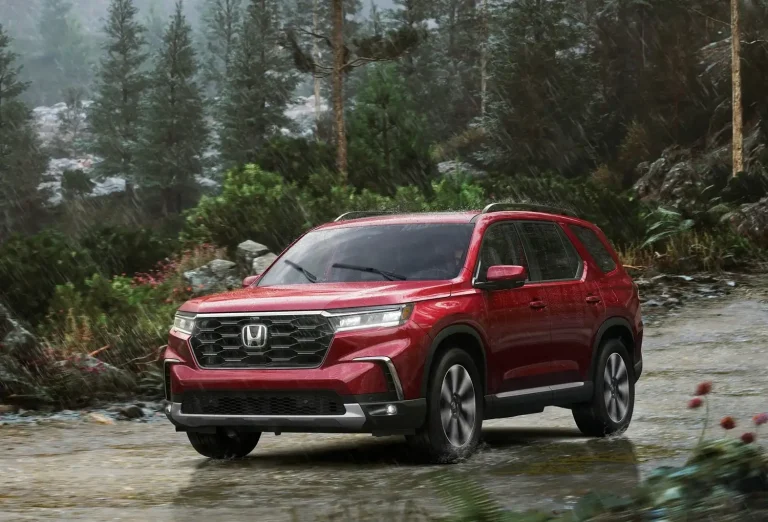
Generation 4 (2023–Present)
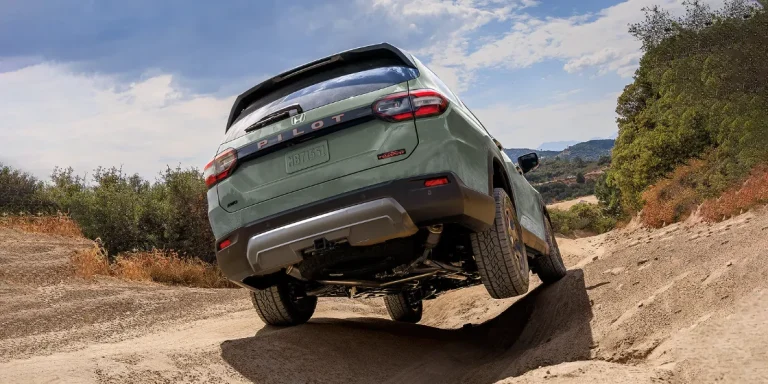
The current Pilot moved to a new 10-speed automatic and, for the first time, added a purpose-built off-road trim — TrailSport — that also happens to be relevant to towing.
- Towing capacity: 3,500 lbs (FWD) / 5,000 lbs (AWD)
- Engine & Transmission: All-new 3.5L DOHC V6, paired with a 10-speed automatic
- TrailSport advantage: TrailSport trims come with an integrated Class III hitch, increased approach and departure angles, and transmission tuning adjusted for its off-road use case
- Mechanical detail: The 10-speed automatic’s shorter first- and second-gear ratios help the Pilot launch a loaded trailer more smoothly and with less heat buildup during the initial pull than the previous 6-speed and 9-speed units
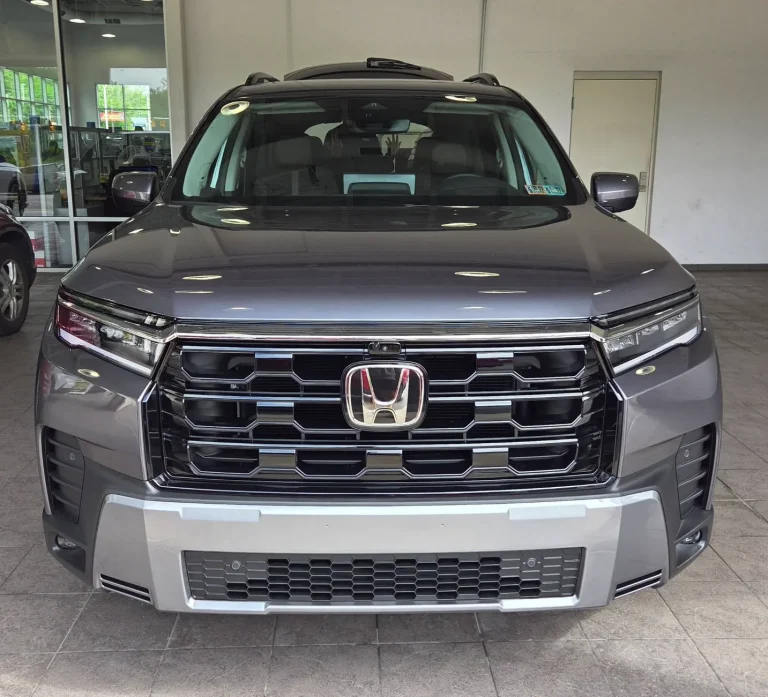
If you’re shopping for a 2026 Honda Pilot and plan to tow with it, I highly recommend adding the towing package to your purchase.
The price is about $895 for the Sport and EX-L trims and $1,140 for the Touring, Elite, and Black Edition trims.
The towing package includes the following:
- Trailer Hitch Harness
- Trailer Hitch
- Trailer Hitch Ball Mount
- Trailer Hitch Panel, Silver
- Trailer Hitch, HFA Adapter
The prices above include installation costs.
Oh, by the way, for the TrailSport model, you don’t need to add a towing package—it’s already included as standard on that adventure-style model.
What Can You Actually Tow?
Numbers on a spec sheet are more useful once you can picture what they translate to in the real world.
At 3,500 lbs (FWD or base configurations), you’re typically looking at:
- A pair of jet skis or personal watercraft on a shared trailer
- A pop-up camper or small teardrop trailer
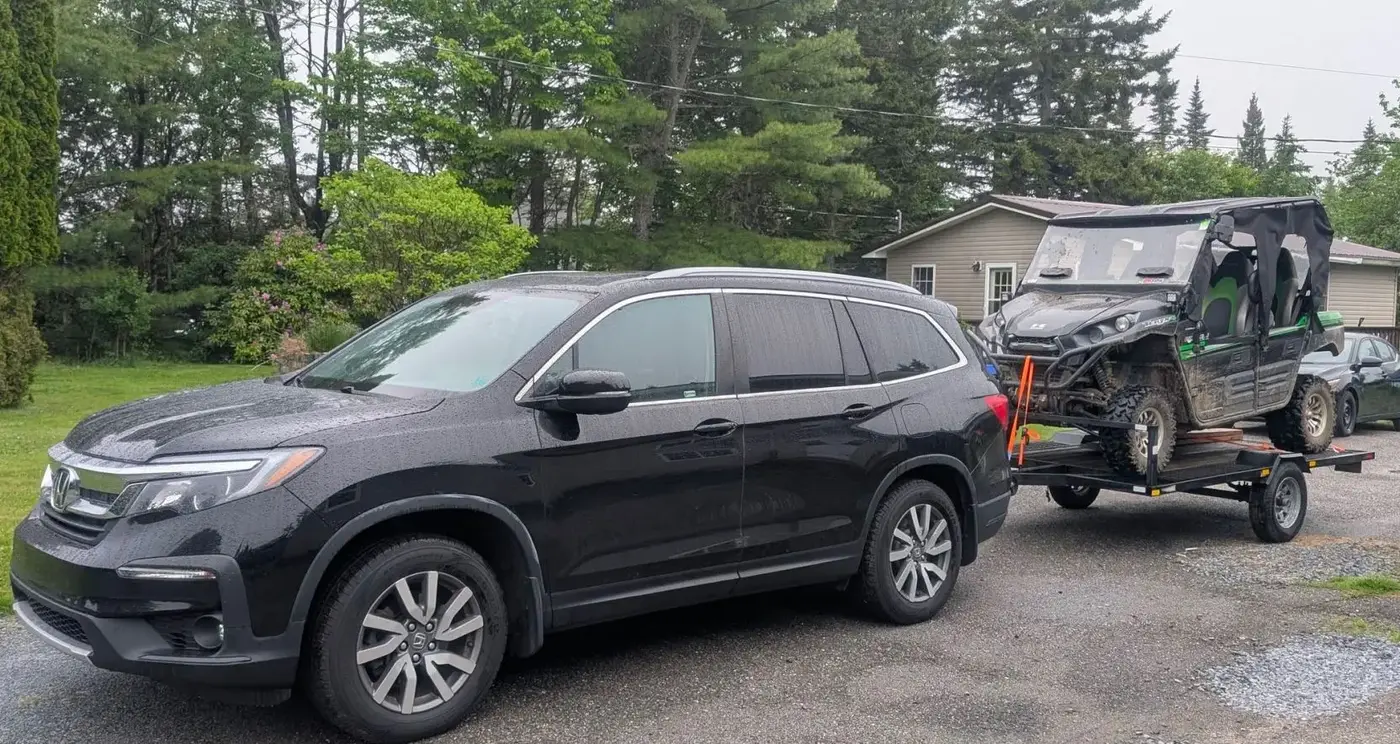
- A small utility trailer carrying a dirt bike or landscaping equipment
- A small aluminum fishing boat and trailer
At 5,000 lbs (properly equipped AWD models), you can generally step up to:
- A mid-size travel trailer or family camper in the 20–24 foot range
- A 20-foot bowrider or ski boat with trailer
- A mid-size enclosed cargo trailer
- A compact Airstream-style travel trailer (Bambi/Basecamp-class)
These are general guidelines based on typical dry weights. Always weigh a specific trailer and its loaded cargo rather than relying on the manufacturer’s advertised dry weight alone, since accessories, water tanks, and gear add up quickly.
To be honest, I don’t tow, so I don’t have any “firsthand” experience with that. But some of my friends in the community and on forums have a lot of experience towing with their Pilots.
One of my colleagues with his 2015 Pilot is running a 3,100-lb Wolf Pup travel trailer — with Honda’s factory auxiliary cooler and a Prodigy P2 brake controller installed. Described the setup as comfortable for two people, though wind resistance became noticeable at highway speed.
Another fellow towing a similar-size trailer said performance exceeded expectations even in gusty conditions, but preferred to hold around 65 mph rather than push closer to 75 when the wind picked up.
On the lighter end, one 2WD Gen 2 owner towed a mid-size travel trailer on regular camping trips for a full season without issue before upgrading to a larger setup.
The common thread across these accounts: owners who install the right cooling and brake hardware, respect tongue weight, and tow somewhat under the rated maximum are the ones reporting the most trouble-free experiences.
Towing Safety and Maintenance
A Pilot within its rated capacity can still run into trouble if it’s not maintained or equipped correctly for regular towing.
Brake controllers and safety chains. Most states require an electric trailer brake controller once trailer weight exceeds roughly 1,500–2,000 lbs, and Honda’s own guidance reflects similar thresholds. Safety chains, rated for the full trailer weight, are a legal requirement in nearly all jurisdictions regardless of trailer size.
Transmission fluid intervals. Regular towing puts more heat and stress on transmission fluid than daily commuting. Owners who tow frequently should plan on more frequent ATF changes than the standard interval — this is one of the simplest ways to protect a Pilot’s transmission over years of towing use.
Tire pressure and load index. Both the Pilot’s tires and the trailer’s tires should be checked before every towing trip — towing changes the ideal pressure since you’re carrying more load than usual, so it’s worth referencing our Honda Pilot Tire Pressure Guide for the correct PSI by model year and load condition. Underinflated tires are one of the most common causes of trailer-related tire failure on long highway trips.
Towing mirrors. Factory mirrors often aren’t wide enough to see around a trailer, boat, or camper. Clip-on towing mirror extensions are inexpensive and meaningfully improve visibility and confidence, especially when merging or backing up.
FAQ
Enjoy an exciting adventure with the Honda Pilot
Every generation of the Honda Pilot is a versatile and reliable vehicle. It’s comfortable for the whole family and sturdy enough for heavy-duty tasks like towing.
Whether you’re towing a utility trailer for work, hauling recreational gear like a boat or jet skis, or even enjoying a camping road trip with a camper trailer, the Honda Pilot can handle it.
Just make sure you stay within the weight limit, and everything will be fine.
Do you have any more questions? Feel free to leave them in the comments section!
Image credit: James007Beast on 2016HondaPilot

a cat lover, Honda driver, automotive enthusiast, and occasional photographer.
Nurjati is a proud Honda SUV owner and passionate content creator dedicated to sharing expert insights about full-size family SUVs.
His first car in school was a Honda, and she’s been in love with the brand ever since. With over 10 years of experience as a journalist and automotive blogger, Nurjati is committed to keeping enthusiasts and buyers informed and inspired.